
Practitioner Guide · Application Workflow
A practical workflow for immigration professionals managing a provincial entrepreneur file — from initial client assessment through to permanent residence confirmation. Built for RCICs and immigration lawyers working with Canadian regional programs.
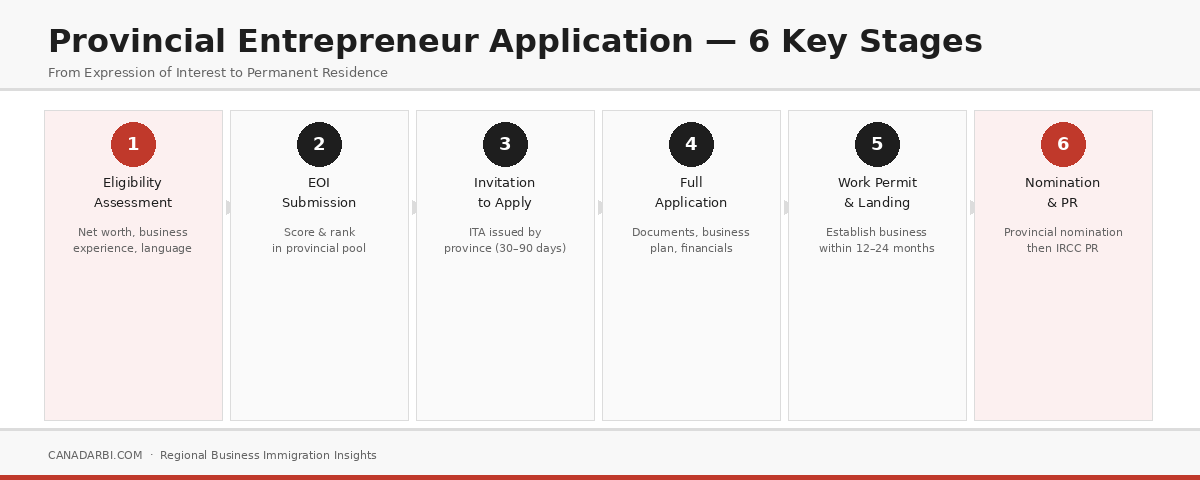
Managing a provincial entrepreneur immigration file is meaningfully different from Express Entry or family sponsorship work. The process involves business plan development, provincial government engagement, a multi-year monitoring phase, and coordination across multiple professional domains. This guide maps the complete workflow so practitioners can set accurate expectations, build the right team, and deliver results.
Step 1: Client Pre-Assessment
Before any program is selected, a rigorous pre-assessment is non-negotiable. This evaluation covers:
- Net worth documentation: Is the declared net worth legally obtained, fully documentable, and does it meet the target program's minimum?
- Business experience: Does the client have ownership or senior management experience in an active business? What industry? For how long?
- Language: What is the client's functional English (or French) level? Some programs require CLB 4–5 minimum.
- Family situation: How many dependents? What are the children's school-age needs? Does the family need PR before relocating?
- Business concept: Does the client have a realistic business idea for Canada, or do they need guidance on viable industries for the target province?
CanadaRBI provides structured pre-assessment reports for partner practitioners. Submit your client's profile and receive a program recommendation with supporting rationale — before you commit to preparing a full file.
Step 2: Program Selection and Strategy
Once the pre-assessment is complete, select the target program based on capital position, business experience, industry fit, and family preferences. Cross-check the program's current intake status — some programs use Expression of Interest scoring, others accept rolling applications. Timeline expectations should be set explicitly at this stage.
For clients who qualify for multiple programs, build a primary and backup strategy. If the client is rejected at EOI stage in BC, what is the next option? Manitoba? Atlantic provinces? Having a ranked list prevents disruption.
Step 3: Business Plan Development
The business plan is the core of the provincial application. A submission-ready business plan for a provincial entrepreneur program typically includes:
- Executive summary with investment and employment projections
- Market analysis specific to the target province (local competitors, demand data, regional economic context)
- Operational plan (location, staffing, equipment, supplier relationships)
- Financial projections (Year 1–3 revenue, expense, cash flow)
- Evidence of prior business experience (financial statements, ownership records)
- Net worth documentation (audited or accountant-certified)
Generic business plan templates fail. The plan must be written with the target province in mind, reference local market conditions, and demonstrate that the applicant understands the specific operating environment.
Step 4: Application Submission and Province Review
After the plan is complete and all supporting documents are assembled, submit through the province's intake mechanism (EOI registration, direct application portal, or intake window depending on the program). Maintain regular follow-up with the province; some programs allow provincial contacts to ask clarifying questions before a decision is made.
Step 5: Work Permit Phase — Business Establishment
After provincial approval of the business plan, the applicant applies to IRCC for an Entrepreneur Work Permit. Processing: 1–3 months. Once the work permit is issued, the client enters Canada and begins the business establishment phase governed by the Performance Agreement.
This phase requires close monitoring. Key milestones:
- A. Months 1–3: Business registration, lease/premises secured, banking established, initial investment deployed
- B. Months 3–9: Business operational, first employees hired (Canadian PR or citizens), revenue generating
- C. Months 9–18: All Performance Agreement commitments met; province monitoring period continues
- D. Month 18–24: Formal compliance verification by province; nomination issued if all commitments are met
Step 6: Federal Permanent Residence Application
After receiving the provincial nomination certificate, the applicant submits a federal PR application to IRCC. Federal processing times vary; check IRCC's current processing times for an up-to-date estimate. The application includes the primary applicant and all family members. Biometrics and medical exams are completed during this phase. PR is confirmed upon IRCC approval.
How CanadaRBI Fits Into Your Workflow
CanadaRBI is the execution infrastructure layer for immigration professionals. Our network handles business plan development, local market validation, provincial liaison, and performance monitoring — allowing your firm to focus on immigration law and regulatory compliance while we manage the business side of the file.
Our partner model is designed for practitioners who want to expand into regional entrepreneur programs without building internal business advisory capacity from scratch.
Connect Your Clients to the Right Provincial Stream
CanadaRBI is the execution partner for immigration lawyers and RCICs delivering regional entrepreneur programs across Canada.